RV Storage Buyer's Guide 2.0

How to choose RV storage with confidence

Compare more than monthly rent. Learn how storage type, security, parking geometry, access, amenities and management affect the experience of owning and using an RV.

Start with the ownership experience

How to choose the right RV storage facility

Choosing RV storage involves much more than comparing monthly prices. Security, access hours, ease of parking, storage type, amenities, lease terms and management can all affect how convenient RV ownership feels.

If two facilities quote different prices, first determine whether they are providing the same kind of storage experience. A lower monthly rate may be the right choice for one owner, while another may place more value on easier maneuvering, better access or useful on-site services.

The central question:
Will this facility make it easier for you to use, care for and feel comfortable storing your RV?

Chapter 1

Understand the type of storage you're buying

Open storage

Open parking places the RV outdoors without overhead cover. It is often the lower-cost option and can accommodate a broad range of vehicle sizes.

Consider: The RV remains directly exposed to sun and weather.

What's in it for me?
A straightforward storage option when convenient access and lower monthly cost are priorities.

Covered storage

Covered parking adds overhead protection while keeping the vehicle accessible from the aisle.

Consider: Covered inventory can cost more and availability may be more limited.

What's in it for me?
Reduced direct sun and weather exposure without moving the RV into a fully enclosed building.

Enclosed storage

Fully enclosed storage places the RV inside a structure and provides the greatest separation from outdoor conditions.

Consider: Enclosed RV storage can be more expensive and is not offered by every facility.

What's in it for me?
An option for owners who place the highest priority on environmental protection.

Match the actual space

Do not evaluate storage type in isolation. Confirm the usable length, width, height clearance where relevant, route to the space and maneuvering room.

What's in it for me?
A storage type and location that fits the vehicle in real-world use, not only on a rate sheet.

Chapter 2

Understand RV storage pricing

Monthly rent can vary because the vehicles and spaces vary. Factors can include vehicle length, open versus covered storage, the individual space's location, maneuverability, availability and premium features.

Why can one space cost more?

  • Pull-through configuration
  • End-of-aisle location
  • Enhanced-lighting location
  • Preferred maneuvering conditions
  • Covered versus open storage
  • Higher-demand size or location

What's in it for me?
A premium should correspond to a practical advantage you actually value.

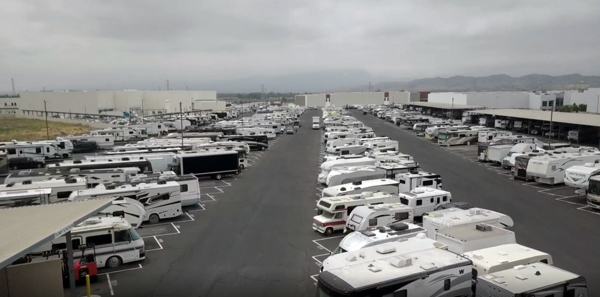
Driveway and organized RV storage areas at McBride's

Chapter 3

Evaluate security as a system

No security feature can guarantee that theft, vandalism or damage will never occur. A useful comparison looks at how multiple measures work together.

Controlled access

Ask how entry is managed and whether access is restricted to authorized users.

Lighting

Look at visibility around drive aisles, entrances and storage areas during dark hours.

Camera systems

Ask whether camera coverage is limited to entrances or extends to other areas of the property.

People and operations

Ask about management presence, patrol activity, property maintenance and how access problems are handled.

Read the security guide

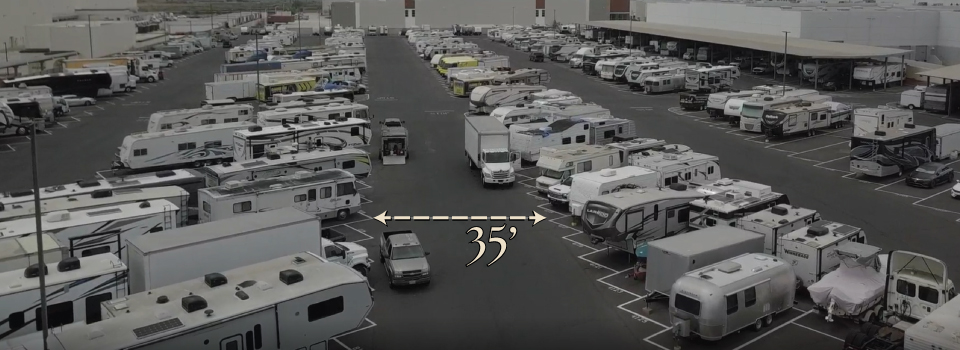
Measurement graphic showing an approximately 35-foot drive aisle between RV storage rows

Chapter 4

Look at the drive aisle before you look at the space

A space may be long enough for the RV and still be inconvenient if the approach leaves too little room to position the vehicle. Evaluate aisle width, turning room, parking angle, neighboring vehicles and the exit route.

Ask to see the actual space

Walk or drive the route a customer would use. Consider whether the space is back-in, pull-through or at the end of an aisle, and where corrections can be made during the maneuver.

What's in it for me?
Less stress and more confidence every time the RV is parked or retrieved.

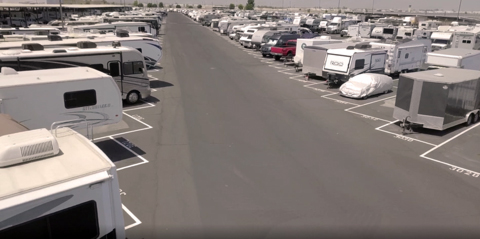
Why wide drive aisles matter

Chapter 5

Decide which amenities create real value for you

Amenity value depends on whether the service removes a task or an extra stop from your normal RV routine.

Wash bay

Useful when cleaning a large RV is difficult at home.

Benefit: Wash where the RV is already stored.

Dump station

Supports an essential post-trip task.

Benefit: Finish cleanup before heading home.

Potable water

Provides clean water for travel preparation.

Benefit: Fill before departure.

Complimentary ice

An everyday convenience that can remove a travel-day errand.

Benefit: One less stop on the way out.

Air

On-site compressed air supports common preparation needs.

Benefit: Address supported air needs at the storage facility.

Vacuum

A high-suction vacuum with reach appropriate for larger vehicles can simplify cleanup.

Benefit: Keep the RV road-ready with fewer off-site errands.

Explore amenities

Chapter 6

Pay attention to who operates the facility

Price, location and physical features are easy to compare. The quality of day-to-day operation can be harder to see before becoming a customer.

During a visit or phone call, pay attention to whether questions are answered clearly, the property appears maintained, policies are understandable and staff can explain how the facility handles practical issues.

What's in it for me?
A well-operated property can make access, billing, maintenance questions and unexpected issues easier to deal with over the life of the rental.

Chapter 7

Boat storage has many of the same decision points

Boat owners should evaluate trailer length, turning room, access hours, security, storage type and the route from gate to space.

If the boat is used frequently, consider how easily the combination can be retrieved, reconnected and returned after a day on the water.

What's in it for me?
A smoother transition between storage and recreation.

Explore boat storage

Wide storage aisle with room for large vehicle and trailer movement

Chapter 8

Businesses and fleets should evaluate operational needs

Commercial storage customers may need multiple spaces, flexible driver access, reliable 24-hour entry and the ability to change the storage footprint as the business changes.

Contractors and fleet operators should consider how vehicles enter and leave the property, who needs access, how space assignments are managed and whether the facility layout supports the vehicles being stored.

What's in it for me?
A storage arrangement that supports the way the business actually operates rather than forcing the business into a consumer parking model.

Explore fleet & business storage

Chapter 9

20 questions to ask before renting RV storage

  1. What are the access hours?
  2. Is customer access available 24 hours?
  3. How is entry controlled?
  4. What security layers are used?
  5. Can I see the actual available space before renting?
  6. What is the usable length of the space?
  7. Is the space open, covered or enclosed?
  8. How much maneuvering room is available?
  9. Is the space back-in or pull-through?
  10. Are end-of-aisle or other premium locations available?
  11. What amenities are included?
  12. Is a dump station available?
  13. Is potable water available?
  14. Is there a wash area?
  15. Are air, vacuum or ice available?
  16. What fees apply at move-in?
  17. What are the payment options?
  18. Are longer-term agreement options available?
  19. How are rent changes communicated?
  20. Who should I contact if I have an access or billing problem?

Chapter 10

Frequently asked questions about RV storage

How much does RV storage cost?

Pricing varies with vehicle size, storage type, individual space location, availability and the services provided by the facility. Compare the specific space and what is included rather than only the advertised monthly number.

What size RV storage space do I need?

Start with the RV's overall stored length and confirm that the available space provides the usable dimensions and maneuvering room required for the vehicle. Ask to see the actual space when possible.

Is covered RV storage worth the additional cost?

Covered storage may be valuable to owners who want to reduce direct sun and weather exposure. Whether the added monthly cost is worthwhile depends on the vehicle and the owner's priorities.

What is a pull-through RV storage space?

A pull-through layout allows the vehicle to enter and leave through the storage position without relying on the same backing maneuver used by a traditional back-in space.

Why do end-of-aisle spaces sometimes cost more?

An end location may offer a preferred approach or additional maneuvering convenience. Facilities may price high-demand locations differently.

Why are wide drive aisles important?

The aisle is the working area used to approach, align, park and retrieve an RV. More working room can make those maneuvers easier.

Does aisle width alone determine whether parking will be easy?

No. Vehicle size, parking angle, approach direction, neighboring vehicles, the actual space location and driver experience also matter.

Should I see my space before renting?

When possible, seeing the actual space lets you evaluate the route, approach, dimensions, neighboring spaces and maneuvering room rather than relying only on a listed size.

Does 24-hour access matter?

It can matter for customers who leave early, return late or want travel plans to determine their schedule rather than facility access hours.

What should I look for in RV storage security?

Consider how access is controlled, lighting, camera coverage, operational oversight, patrol activity and property maintenance as parts of a layered system.

Can a storage facility guarantee my RV will never be stolen or damaged?

No security program can eliminate all risk. Evaluate the measures used to manage risk and review your own insurance and storage requirements.

Is a dump station valuable at an RV storage facility?

For active RV owners, an on-site dump station can remove a separate post-trip stop and make the return routine more convenient.

Why would potable water at storage matter?

Potable water can let an owner handle supported travel preparation where the RV is stored instead of making another stop.

Does a wash bay really add value?

It can for owners who otherwise need to locate a place capable of accommodating a large RV. The value depends on how often the owner cleans the vehicle and what alternatives are available.

Why would an RV storage facility provide ice?

For customers preparing to travel, on-site ice can eliminate an ordinary departure-day errand.

What is a premium RV storage space?

A premium space is a location priced above a standard space because it offers a valued feature such as pull-through access, an end-of-aisle position, enhanced lighting or another high-demand characteristic.

Should I choose the cheapest RV storage facility?

Choose based on the factors that matter to you. Monthly rent is important, but access, parking difficulty, security approach, amenities and management can affect the total experience.

What should boat owners compare?

Boat owners should consider trailer dimensions, turning room, access, security, storage type and how easily the boat-and-trailer combination can enter and leave the space.

What should business fleet customers compare?

Commercial customers should consider vehicle access, multiple-space needs, driver access, operating hours, security and the ability to adjust storage needs as the business changes.

What is the best way to compare two storage facilities?

Compare the actual spaces, access rules, security layers, parking geometry, included amenities, fees, management experience and total monthly cost. A tour can reveal practical differences that are difficult to see on a price list.

Final checklist

Choose the facility that makes RV ownership work better for you

The right answer is not the same for every customer. Before signing, decide which factors affect your real ownership experience: how often you travel, the size of the RV, the level of protection you want, when you need access, how comfortable you are maneuvering the vehicle and which on-site services you will actually use.

A simple decision rule:
Choose the storage facility that gives you the best combination of fit, access, security, convenience and value for the way you use your RV.

Find the right space

Ready for a better storage experience?

Call for current availability, space recommendations and the price range that fits your vehicle.